Flying on a Plane
My Story
Developed by Paul Rawe
📖 What does it mean: Flying on a plane?
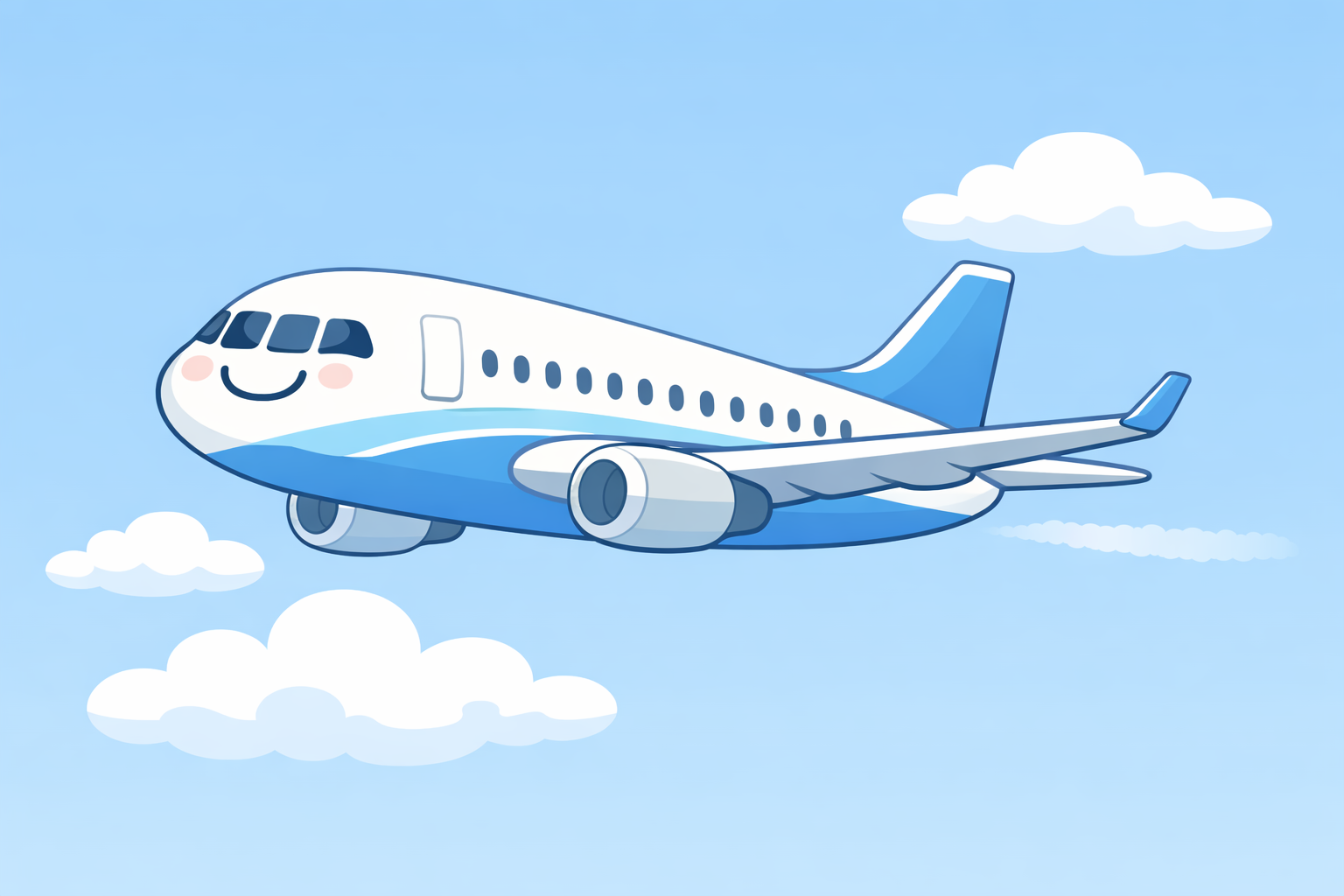
Flying on a plane means that I travel with a large airplane from one place to another place. The airplane flies high in the air, above clouds and countries.
An airplane is like a big bus – except it flies instead of driving on the road.
- To reach faraway places quickly
- To go on vacation
- To visit family or friends
- Because flying is faster than car or train
Many millions of people fly every day. Flying is safe and normal.
A flight can be short (1-2 hours) or long (5-10 hours or more).
📅 Preparing for the Flight
My Flight:
From: _______________ To: _______________
Date: _______________
Departure time: _______________
Flight number: _______________
Who's coming with me: _______________
⏱️ How long does everything take?
A flight day consists of several parts:
- Arrival at airport: 2-3 hours before departure
- Check-in & security: 30-60 minutes
- Waiting at gate: 15-45 minutes
- Boarding: 20-30 minutes
- The flight itself: varies (e.g., 2 hours)
- Getting off & baggage: 20-40 minutes
🎒 What should I bring?
- Passport or ID card
- Boarding pass (often digital on phone)
- Small carry-on bag (backpack or bag)
- Headphones (to dampen noise)
- Book, tablet, or something to read/play with
- Snacks (if allowed) and empty water bottle
- Optional: Gum (helps with ear pressure)
- Optional: Stuffed animal or comfort object
👣 Step by Step: What happens on flight day?
- Arrival at the Airport
We arrive at the airport 2-3 hours before departure. The airport is a large building with many people. There are signs showing the way. - Check-in
First we go to check-in. There we drop off our large suitcases (if we have any). We get our boarding passes. Sometimes this is already done online and we skip this step. - Security Check
Then we go to security. Here we have to go through a metal detector. We put our phone, keys, and jacket in a bin. The luggage is scanned. This is normal and serves everyone's safety. - Waiting in the Terminal
After security, we're in the "terminal" – that's the waiting area. There are shops, restaurants, and benches here. We look at our boarding pass to see which gate we need (e.g., "Gate A12"). - Going to the Gate
About 30-45 minutes before departure, we go to our gate. The gate is the waiting area right before the plane. We sit down here and wait. - Boarding (Getting On)
When boarding begins, our name or seat number is called. We show the boarding pass and walk through a long corridor (jet bridge) directly into the plane. - Finding Seat and Sitting Down
On the plane, we look for our seat. The number is above the seat (e.g., "15A"). We sit down, put our carry-on under the seat or in the overhead bin. We buckle up. - Safety Announcement
The flight attendants show what to do in an emergency. This is a routine done on every flight. It doesn't mean something bad will happen. - Takeoff
The plane rolls to the runway. It goes faster and faster until it lifts off. You feel a slight pressure in your stomach (like on a roller coaster). After 5-10 minutes the plane is in the air and it gets calmer. - During the Flight
Now we can loosen the belt (but not remove it). We can read, listen to music, sleep, or look out the window. On longer flights there's food and drinks. I'm allowed to get up and go to the bathroom. - Landing
Before landing, they say: "Please fasten seatbelts." The plane descends slowly. There's a small jolt when the wheels touch the ground. Then the plane rolls to the parking position. - Getting Off
When the plane has stopped, we're allowed to stand up. We take our carry-on and walk out of the plane in a line. We follow the signs to baggage claim (if we have luggage). - Picking Up Luggage
At baggage claim, we wait until our suitcases appear on the conveyor belt. We take them and go to the exit. - Arrived at Destination
We're here! The flight is over. Everything went well.
👀 What will I see, hear, and feel?
👁️ Seeing
- Many people at the airport
- Large display boards with flight numbers and times
- Long corridors and escalators
- The airplane from outside (large and with wings)
- Seats in the plane in rows
- Clouds and sky out the window
👂 Hearing
- Many voices and announcements at the airport
- Beeping from security scanner
- Announcements over loudspeaker
- Engine noise when the plane starts
- A humming sound during the flight
- Sometimes a ding sound in the plane (that's normal)
✋ Feeling
- A slight pressure in stomach during takeoff and landing
- Sometimes pressure in ears (can chew gum or swallow)
- The seat under me (sometimes a bit bumpy when there's turbulence)
- The seatbelt around my waist
⚠️ What might be difficult?
Challenge 1: The airport is loud and crowded
At the airport there are many people, announcements, and noises. That can be overwhelming.
Solution:
- Wear noise-canceling headphones or earplugs
- Hold Mom/Dad's hand
- Look for a quiet corner to wait
- Focus on one thing (e.g., a book or game)
Challenge 2: Sitting still for a long time
On the plane I have to sit in my seat for a long time. That can be difficult.
Solution:
- Bring activities (book, tablet, coloring book)
- I'm allowed to get up and stretch during the flight
- Listen to music or an audiobook
- Look out the window (clouds are interesting!)
Challenge 3: Ear pressure
During takeoff and landing my ears might feel strange or hurt. That's pressure.
Solution:
- Chew gum
- Swallow often
- Yawn
- Drink something
- Pinch nose and gently blow (helps equalize pressure)
Challenge 4: Turbulence (bumpy air)
Sometimes the plane shakes a little. That's called turbulence. It can feel like driving over a bumpy road.
Solution:
- Know that this is completely normal and safe
- The pilot knows what to do
- Keep seatbelt fastened
- Hold Mom/Dad's hand
- Take deep breaths
Challenge 5: Fear or nervousness
I might be scared because flying is new to me. That's okay.
Solution:
- Know that flying is very safe (safer than driving)
- Breathe deeply in and out (breathing technique)
- Think of something nice (e.g., the vacation destination)
- Talk to Mom/Dad
- Hold a stuffed animal or comfort object
🛠️ What can help me?
✋ I can always speak up
If something becomes too much, I'm allowed to say it:
- "It's too loud for me."
- "I need a break."
- "I don't feel well."
Mom or Dad will help me.
😤 Breathing Technique
When I'm nervous:
- Slowly breathe in through nose (1-2-3-4)
- Briefly hold breath (1-2)
- Slowly breathe out through mouth (1-2-3-4-5-6)
- Repeat three times
🧸 Comfort Object
I'm allowed to bring something calming:
- A small stuffed animal
- A fidget spinner
- A stone or another small object
I can hold this in my hand during the flight.
💬 Asking Questions
I'm allowed to ask questions:
- "How much longer is the flight?"
- "What was that noise?"
- "When can we stand up?"
👨👩👧 Mom/Dad is with me
Mom or Dad sits right next to me on the plane. They're watching over me. I'm not alone.
🎉 After Landing
✅ I did it!
The landing is over. I flew! That was brave and great.
Now I'm at the destination and can be happy.
🏠 At the Destination
After the flight we can:
- Go to the hotel or accommodation
- Eat and drink something
- Rest
- Enjoy the vacation or visit
⭐ I'm proud of myself!
Flying is exciting for many people – even for adults.
I mastered a big challenge!
Next time it will be easier because now I know how it works.
📝 My Personal Notes
Where are we flying and why?
What am I bringing in my carry-on?
What worries me most?
What helps me stay calm?
What am I looking forward to at the destination?
👨👩👧 Information for Parents
Preparation at Home
- Read this story together daily 5-7 days before the flight
- Watch YouTube videos of airports and flights
- Playfully act out "flying" (arrange chairs as seats)
- Talk about the destination and build anticipation
At the Airport
- Be there early enough (avoid time pressure)
- Look for quiet waiting area (away from noisy areas)
- Have snacks and activities readily available
- Ask airline for support (e.g., priority boarding)
During the Flight
- Stay calm – your calmness transfers to the child
- Praise small steps ("You're sitting great in your seat!")
- Offer distraction, but don't force it
- Ask flight attendants for help if needed
💡 Additional Tips
- Some airlines offer special support for families with autistic children
- Window seat can be calming (view outside)
- Aisle seat allows easier standing up
- Night flights can be quieter (fewer people, child is tired)